
09.07.2026
Better Weather Forecasts: Beyond Gravity Supports NASA Weather Satellite Missions
Launching in 2032, new weather satellites from NOAA and NASA will provide more precise weather forecasts. The precise position in orbit will be determined by a navigation receiver for geostationary orbit from Beyond Gravity, an international space supplier.
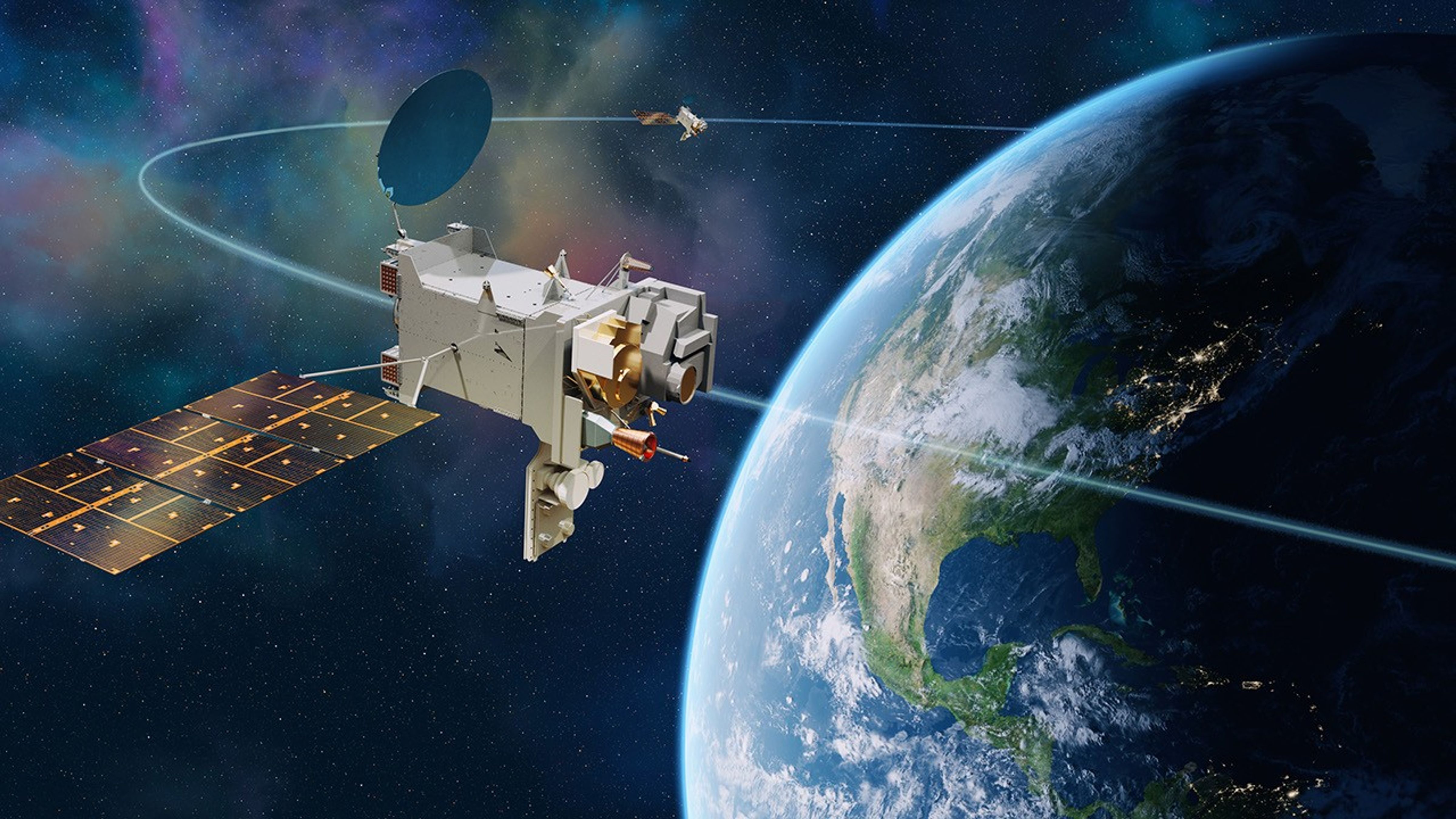
The latest generation of NOAA weather satellites that will be built by Lockheed Martin, will be launched into space starting in 2032. The satellites’ precise in-orbit positioning will be determined using technology from Beyond Gravity. “For our first contract with Lockheed Martin, we will supply navigation receivers for two NOAA weather satellites. The more accurately the position of the satellite is determined by our receiver, the more accurate the weather and environmental data will be,” says Kurt Kober, Vice President Electronic Solutions from Beyond Gravity, a leading space supplier headquartered in Zurich, Switzerland. The NOAA GeoXO (Geostationary Extended Observations) satellites will operate at an altitude of approximately 36,000 kilometers from Earth (22,236 miles). The information GeoXO supplies will improve short-term forecasting and warning of severe weather and hazards in the Western Hemisphere.
“New benchmark for precision on-board real-time navigation”
“Our GEORIX navigation receivers are developed specifically for geostationary Earth orbit and provide an accuracy of less than 20 meters at an altitude of 36,000 kilometers. This sets a new benchmark for precision on-board real-time navigation”, says Kurt Kober. The high-performance, multi-constellation GNSS receivers are being developed and produced at the Austrian Vienna site of Beyond Gravity. In 2023, the first GEORIX navigation receiver was sent into space and determines the position of the NASA climate instrument TEMPO as it measures atmospheric gases (ozone, nitrogen dioxide and formaldehyde) and aerosols over North America. Currently, about 30 satellites use navigation receivers from Beyond Gravity to determine their position. The receivers are used for satellites from Low-Earth Orbit (LEO) to Geostationary Earth Orbit (GEO), about 1,000 kilometers to 36,000 kilometers from Earth.
Technical features of GEORIX: highly configurable
The navigation receiver from Beyond Gravity for geostationary orbit, GEORIX, incorporates an antenna optimized for geostationary earth orbit; detached Low Noise Amplifiers, and advanced technology such as an accurate force model-based orbit propagator and state-of-the-art Kalman filtering. The GEORIX navigation receiver offers a flexible acquisition and tracking concept, single-frequency signal processing of up to 12 satellites. The spaceborne navigation receiver GEORIX is highly configurable and features a powerful parameter interface that supports changes in both standby and operational modes.
About Geostationary Extended Observations (GeoXO): Weather data until 2055
The GeoXO constellation will include two operational satellites — east and west. Geostationary Extended Observations (GeoXO) is a collaborative National Oceanic and Atmospheric Administration (NOAA) and NASA program that will provide continuous imagery and data on Earth’s atmosphere, land and ocean for operational forecasts and warnings. NASA, on behalf of the National Oceanic and Atmospheric Administration, has selected Lockheed Martin in Colorado, to build the spacecraft for NOAA’s Geostationary Extended Observations satellite program. The first GeoXO launch is planned for 2032, as the GOES-R satellites are nearing the end of their operational lifetime. The GeoXO mission will maintain and advance NOAA’s geostationary Earth observations through 2055.
GeoXO will provide advanced imagery and atmospheric measurements of Earth’s Western Hemisphere and real-time mapping of lightning activity. GeoXO will support short-term forecasts and warnings of extreme weather and environmental hazards.
About NOAA’s Geostationary Weather Satellites
Since 1975, NOAA’s Geostationary Operational Environmental Satellites (GOES) have provided continuous imagery and data on atmospheric conditions and solar activity (space weather). GOES data products have led to more accurate and timely weather forecasts and better understanding of long-term climate conditions. GOES satellites orbit 22,236 miles above Earth’s equator, at speeds equal to the Earth’s rotation. This allows them to maintain their positions over specific geographic regions so they can provide continuous coverage of that area over time.
More about navigation solutions from Beyond Gravity:
https://www.beyondgravity.com/en/satellites/electronic-solutions/navigation-receivers
About Beyond Gravity
Beyond Gravity, headquartered in Zurich, Switzerland, is the first space company to combine a startup mindset, agility, speed and innovation with decades of experience and proven quality. Approximately 1900 employees at 12 locations in six countries (Switzerland, Sweden, Austria, USA, Finland and Portugal) develop and produce solutions for satellites and launch vehicles with the goal of advancing humankind and enabling the exploration of the world and beyond. Beyond Gravity is the preferred supplier of structures for all types of launch vehicles and a leading provider of selected satellite products and constellation solutions in the New Space sector. In 2025, the company generated a revenue of around CHF 402 million. More information at: www.beyondgravity.com


Images
Image 1: The NOOA weather satellites GeoXO will deliver crucial data on Earth’s atmosphere. © NASA.
Image 2: The navigation receiver from Beyond Gravity for geostationary orbit, GEORIX, will determine the in-orbit position of the NOAA GeoXO (Geostationary Extended Observations) satellites, which will operate 36,000 kilometers (22,236 miles) above Earth. © Beyond Gravity.
Image 3: “Our GEORIX navigation receivers are developed specifically for geostationary Earth orbit and provide an accuracy of less than 20 meters at an altitude of 36,000 kilometers. This sets a new benchmark for precision on-board real-time navigation”, says Kurt Kober, Vice President Electronic Solutions at Beyond Gravity. © Beyond Gravity.